Saturday, November 7, 2009

ARREST LIBYAN LEADER Mu'ammar al-Qaddafi Today in New York


As the world's nations gather on September 23, 2009 in New York for the first United Nations Security Council day-long summit meeting on nuclear disarmament and nuclear non-proliferation, under the chairmanship of President Barack Obama, Libyan leader Mu'ammar al-Qaddafi will be making his first-ever appearance at the world platform. While the United States has officially removed Libya from their list of nations which sponsor terrorism, thus allowing his appearance, there are thousands of followers of Imam Musa al-Sadr, a revered Muslim leader from Lebanon, who don't agree.


On August 31, 1978, Lebanese religious leaders Imam Musa al-Sadr and Sheikh Muhammad Yacoub, along with journalist Abbas Badreddin, were on an official state visit to Libya. On that day 31 years ago, they were last seen leaving their hotel with presidential escort for a meeting with Qaddafi. They have been missing since.

All entreaties to the Libyan government have come to no avail, despite persistent reports that the Imam and/or his companions are alive. Instead, there have been alternating threats of bodily harm and offers of financial bribes to the families of the missing and their lawyers; total denial and stonewalling from the Libyan authorities; and the deliberate planting of disinformation that the Imam left Libya and went to Italy on the night of August 31. Twice, in 1979 and in 1982, investigative judges in Italy have denounced these fabrications. Mostly the pattern of the Libyan authorities has been a continued denial of the kidnapping, despite a televised address of Qaddafi in August 2002, wherein he acknowledged that "the Imam had disappeared here, in Libya."

After more than twenty years of fruitless mediation by political leaders the world over, the families of the disappeared brought a case in Lebanon, of which the Imam and his companions are citizens. In the wake of seven years of a harsh battle in court, investigative Judge Samih al-Hage issued a thirty-page long judgment on 21 August 2008, "indicting the accused Mu'ammar al-Qaddafi... for conspiracy in kidnapping and sequestering" the Imam and his two companions. He is supported in his conclusion by Lebanon's two successive prosecutor-generals.

On the basis of that investigation, arrest warrants have been issued for Qaddafi and seventeen others involved in the disappearing of the Imam and his two companions. We hereby ask the United Nations to let justice take its full course, and to have Qaddafi arrested.

Nothing demeans the UN Charter as much as those who, like Qaddafi, are guilty of the most egregious international crimes and yet retain the privilege of using the UN as a platform to speak to the world. This pattern of impunity has prevailed over forty years of Qaddafi's dictatorship. The 1998 Lockerbie tragedy is well known, with 270 lives lost. But the main victims over the past four decades have been the people of Libya. A few weeks ago, Fathi Jahmi, a human rights advocate and prisoner of conscience, was released from
Libya's prisons to die abroad, so as to further avoid the anger of human rights organizations. Mansur Kekhia, a household name in Libya, was kidnapped in Cairo in 1993, and has been missing since. In 2002, Amnesty International released a report on the freeing from Libyan prisons of 'tens of prisoners, including prisoners of conscience and possible prisoners of conscience.

Among the prisoners of conscience were Muhammad 'Ali al-Akrami, al-'Ajili Muhammad 'Abd al- Rahman al-Azhari, Muhammad 'Ali al-Qajiji, Salih 'Omar al- Qasbi and
Muhammad al-Sadiq al-Tarhuni, who have been imprisoned for almost three decades, following their arrest in 1973." How many other thousands of Libyans have disappeared, been killed, or continue to rot in prison whose names we do not know?

For three decades, the people of Imam Musa al-Sadr across the world have been deprived of his leadership as the bridger of civilizations and religions that he was known for. Torture persists for his family and the families of his two companions, and they will accept nothing but the immediate safe release of their loved ones and the accountability and criminal responsibility of Qaddafi for their disappearance.

We associate ourselves with their fight for truth and justice, and expect the United Nations, under its charter for peace, to work with the authorities in New York and serve the arrest warrant to Mu'ammar al-Qaddafi upon his appearance at the Security Council.

Qaddafi indicted in Imam Musa Sadr Case
Investigative Judge, Lebanese Judicial Council, 21 August 2008 [Conclusions of the Investigative Judge with the Judicial Council, Samih al-Hajj, indicting Qaddafi and six other Libyans for abducting Imam Musa Sadr and his two companions Muhammad Ya'qub and 'Abbas Badreddin.]

We decide... as follows:
1. To indict the defendant Mu'ammar al-Qaddafi in accordance with Art. 569/218 of the Lebanese Criminal Code for conspiracy to abduct, and withhold the liberty of, each of Imam Sayyed Musa al-Sadr and Shaykh Muhammad Ya'qub and journalist 'Abbas Badreddin, for the crime perpetrated on 31/8/1978.

2. To indict each of the defendants: Al-Marghini Mas'ud al-Tumi, Ahmad Muhammad al-Hattab, al-Hadi Ibrahim Mustafa al-Saawi, 'Abd al-Rahman Muhammad Ghawila, Muhammad Khalifa ibn Sahnun, and 'Isa Mas'ud Àbdallah al-Mansuri, whose identities have been fully detailed above, in accordance with Article 569/213 of the Lebanese Criminal Code, for participating in the abduction of Imam Sadr and his two companions.

3. To indict the defendants: Mu'ammar al-Qaddafi , Al-Marghini Mas'ud al-Tumi, Ahmad Muhammad al-Hattab, al-Hadi Ibrahim Mustafa al-Saawi, 'Abd al-Rahman Muhammad Ghaqila, Muhammad Khalifa ibn Sahnun, and 'Isa Mas'ud Àbdallah al-Mansuri, in accordance with Article 2 of Law 11/1/1958.

4. To charge the defendants mentioned in paragraph 3 for the felonies committed under Articles 317, 463, 463/454/213 and 392/213 of the Criminal Code.

5. To issue an arrest warrant against all the above mentioned defendants and bring them handcuffed to the jail attached to the Judicial Council in Beirut.

6. To join the felonies with the crimes for their complementarity.

7. To issue a continued investigation warrant for the full identification of the defendants: 'Abd al- Salam Jallud, Mahmud Muhammad ibn Kura, Ahmad al-Atrash, 'Isa al-Ba'ba', 'Ashur al-Firtas, 'Ali 'Abdal-Salam al-Turaiki, Ahmad Shehata, Ahmad Mas'ud Saleh Tarhun, Ibrahim Khalifa 'Umar, Muhammad ibn 'Ali al-Ruhaibi, and Muhammad Uld Dada.

8. To make indictees and charged bear all costs and fees.

9. To return the file to the Attorney General with the Judicial Council for deposition with the relevant authority.

source

Monday, November 2, 2009

Who is Imam Musa Sadr?


Seyyed Musa Sadr, born in 1929 in Qom –Iran to the prominent Labanese Sadr family of theologians. He was an Iranian –born Lbanese philosopher and a prominent Shia religious leader who spent many years of his life in Lebanon as a religious and political leader.

Education
His fsther was Ayatollah Sadr ad –Din Sadr. Imam Musa Sadr attended his primary school in his hometown and then moved to Tehran. In 1956 he got a degrre in Islamic jurisprudence and political sciences from Tehran University. Then he moved back to Qom and studied theology and Islamic philosophy under Allameh Tabatabaie (Great contemporary philosopher).
Eventually he travelled to Najaf to continue his eduation.

Activities
In 1960 he accepted an invitation to become the leading Shiite figure in Tyre (town in southern Lebanon).
In 1969, Imam Musa was appointed as the first head of Supreme Islamic Shia Counsil.
In 1974 he founded the "Movement of the disinherited" to press for better economics and social conditions for the Shia.
He established a number of schools and medical clinics throughout southern Lebanon.

Disappearance
In August 1978 Imam Musa Sadr and the two companions departed for Lybia to meet with government officials. They were never heard from again. Lybia has consistently denied responsibility. Some have reported that Imam Musa Sadr remains secretly in jail in Lybia.

source

Thursday, October 29, 2009

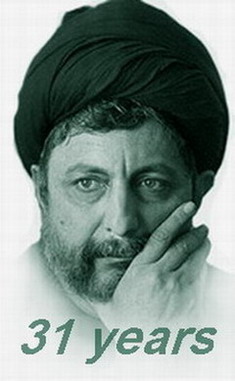
31st anniversary of the disappearance of Imam Musa al-Sadr


Rabab Sadr, the sister of Imam Musa al-Sadr, attends a rally by members of the Amal movement to mark the 31st anniversary of the disappearance of al-Sadr, who was the founder and leader of the Amal movement in Lebanon, in Beirut's suburbs August 31, 2009. REUTERS/ Sharif Karim (LEBANON CONFLICT POLITICS)


Shi'ite House Speaker Nabih Berri (R) and Shi'ite Mufti Sheikh Abdel Amir Qabalan attend a rally organised by members of the Amal movement to mark the 31st anniversary of the disappearance of Imam Musa Sadr, who was the founder and leader of the Amal movement in Lebanon, in Beirut's suburbs August 31, 2009. REUTERS/Sharif Karim (LEBANON POLITICS CONFLICT)


Relatives of suspects accused of plotting attacks on behalf of Lebanon's Hezbollah group leave a court in New Cairo, August 23, 2009. Egypt began the trial on Sunday of 26 men suspected of links with Lebanon's Hezbollah and who face charges that include planning attacks inside Egypt. The charges against the 26, read out in the emergency state security court, included giving information to a foreign organisation, planning attacks inside Egypt on tourist sites and the Suez Canal and possession of explosive material. REUTERS/Stringer (EGYPT CRIME LAW POLITICS CONFLICT)

source

Monday, October 12, 2009

Gaddafi is an abductor


Imam Musa Sadr has been imprisoned in Libya's prison for 31 years ... Muammar Gaddafi abducted Imam Musa Sadr


Gaddafi - muammar Gaddafi - moammar al-Gaddafi - algaddafi - imam sadr - imam musa sadr - imam mousa sadr - free imam sadr - abductor gaddafi - qaddafi - Qaddafi -Alqaddafi - musa sadr -Imam Musa Sadr - Libya - Muammar al-Gaddafi - algathafi - Gathafi

Saturday, September 26, 2009

Amal movement's members in front of the UN

Qaddafi FREE Imam Sayed Musa Sadr
Amal movement's members in front of the United Nations
(when Gaddafi speeched at the UN)

Wednesday, September 2, 2009

Imam Moussa Sadr, The Man Who Disappeared For Lebanon's Sake 31 Years Ago


31 hard years have passed and people - whether contemporary of him or not - are still hoping to see him again. He’s the Imam whose Muslims and Christians alike miss; the Imam whose whereabouts remain a secret within a secret inside Libya where Imam Moussa Sadr had traveled to seek support against the 1978 Israeli war on Lebanon.

The 31st of August of every year, marks the date of the 1978 kidnapping of Imam Sayyed Mussa Sadr in Libya. The Imam is considered one of the most prominent Muslim Shiite figures who sought to apply the message of religion in real life. He adopted the causes of the oppressed and the poor. Imam Sadr was also among the religious figures who contributed in launching the Islamic-Christian dialogue in Lebanon, at a time civil war was ruining this country. The Imam did not have any ties with Libya or its rulers, however he decided to visit Tripoli in the wake of the 1978 Israeli invasion of Lebanon, as part of a tour of Arab countries to rally support and prepare for an Arab summit over the war.

Then Algerian President Hawari Boumedian, suggested that the Imam visits Libya for that purpose as Moammar Ghaddafi was a key player in the course of the political and military situation in Lebanon. Imam Sadr left Beirut's international airport for an official visit to meet Ghaddafi in Tripoli on the 25th of August 1978, accompanied by Sheikh Mohamad Yaacoub and journalist Abbas Badreddine.

According to reports, the trio stayed in the "Shate' Hotel" in Tripoli, however the Imam's visit was not mentioned in Libyan media and every contact with him was cut. Witnesses said that they saw the Imam and his two companions leave the hotel in an official convoy on the 31st of August, the date set for their meeting with Ghaddafi. The Libyan president however denied the meeting ever took place, even though reports say that he confirmed the date was set on the 31st of August at 1:00pm. The same reports said that the meeting did take place and deep differences between Ghaddafi and the Imam surfaced pertaining to the crisis in Lebanon. They added that Kings and rulers intervened in vain to sort out these differences.

Sayyed Sadr and his companions disappeared and they were never heard of until this very day. Libyan authorities claimed that Sadr, Yaacoub and Badreddine had left Tripoli for Rome, as Ghaddafi refrained from addressing the issue with then Lebanese president Elias Sarkis. An investigative panel was formed to carry out a fact finding mission in Tripoli and Rome, but Libya refused to receive the panel. Investigators concluded that Imam Sadr and his companions had never left Libya and did not check into Italy. Rome conducted two rounds of investigations into the case and authorities concluded that Libyan claims were baseless.

For their part, Lebanese authorities considered the disappearance of the Imam and his companions as a crime against the state's internal security and took legal action. On the 30th of August 2001, Amnesty International issued its first report on the disappearance of Imam Sadr and his companions and stressed allegations that they had left Tripoli contradict the outcome of the Italian investigation.

Imam Sadr was born in the holy city Qom, Iran in 1928 to the prominent Sadr family of theologians. His father was Ayatollah Sadr al-Din al-Sadr, while Ayatollah Muhammad Baqir al-Sadr was his cousin. He attended his primary school in his hometown and then moved to the Iranian capital Tehran where he received in 1956 a degree in Islamic Jurisprudence and Political Sciences from Tehran University. He then moved back to Qom to study theology. Eventually he left Qom for Najaf to study theology under Ayatollah Sayed Muhsin al-Hakim and Ayatollah Sayyed Abul Qasim Khou'i.

The Sadr family is originally a Lebanese family, and in 1960 Musa al-Sadr accepted an invitation to become the leading Muslim Shi'ite figure in the Lebanese southern city of Tyre. He was a vocal opponent of Israel. In 1969 he was appointed as the first head of the Supreme Islamic Shi'ite Council, an entity meant to give the dacades-long oppressed Shi'ites more say in government. In 1974 he founded the Movement of the Deprived to press for better economic and social conditions for the Shi'ites. He established a number of schools and medical clinics throughout southern Lebanon, many of which are still operating today.

Sayyed Sadr was also the founder of the first armed resistance in Lebanon against the Israeli occupation, under the name Lebanese Resistance Brigades Movement, Arabic for Amal Movement.

source